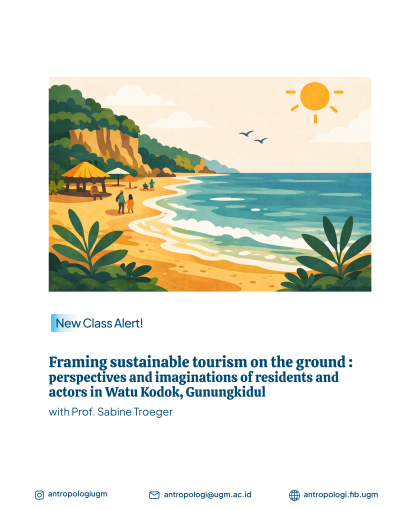
Department of Anthropology opened a new class with the title “Framing Sustainable Tourism on the Ground : Perspectives and Imaginations of Residents and Actors in Watu Kodok, Gunungkidul”
The global challenge of environmental and societal sustainability has become a key guiding principle in both human relevance and academic discussions. As Anthropology focuses on cultural systems, the diversity of human societies, and relations of power and dominance, the topic of Sustainable Tourism has become an important discourse within the field.
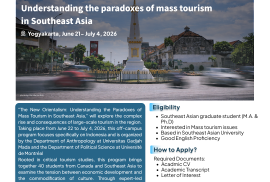
This class explores sustainable tourism in Gunungkidul through an anthropological perspective, using the theme “Gunungkidul, the Next Bali” as a critical reference point. It examines questions like tourism by and for whom, who truly benefits, and how tourism expansion shapes local communities. The main field site is Watu Kodok (Gunungkidul)—a growing tourism area in the Gunung Sewu karst region, connected to popular coastal tourism routes and local tourism initiatives.
The class runs for 8 weeks: the first 4 weeks focus on theory, literature, and research methods (including Participatory Approach / PRA), followed by 4 weeks of practical work with 1 fieldwork day + 1 meeting per week (field days rotate to fit student schedules). Students will complete a PPT presentation, a fieldwork report, and a final theory-guided analysis, while gaining strong skills for field-based research, critical analysis, and thesis writing.
Students may enroll in this course during the KRS registration period by selecting the course titled “Framing Sustainable Tourism on the Ground – perspectives and imaginations of residents and actors in Watu Kodok, Gunungkidul.”
This class will be taught in English
For more information: http://ugm.id/TourismClass2026