Class Fieldwork Report by Cynthia Christyananta and Prof. Sabine Troeger
Throughout February until April 2026, 15 Anthropology students (undergraduate and graduate) from Gadjah Mada University/FIB participated in the named Class in Anthropology, conceptualized and led by Visiting Professor Dr. Sabine Troeger from Germany/University of Bonn. The keywords ‘Sustainability’ and ‘Tourism’ link the class perspectives with a) the normative framework of development challenges in terms of ‘Ecological Integrity’, ‘Economic Viability’, and ‘Social Justice’ as defined by UNWTO and UNEP, the Brundtland Report ‘Our Common Future’ (1987) to be replicated in its tripartite structure 2015 by the SDGs across their 17 goals, and b) the dimension of tourism development in Indonesia, one of the strategic sectors in Indonesia’s national development. The report ‘Our Common Future’ is one of the most important political foundations of the UN Sustainable Development Goals (SDGs). It established the basic idea of environmental protection, economic development, and social Justice, taken together and interlinked, while SDGs embody this philosophy, vocabulary, and moral argument in a concrete, measurable, and politically agreed-upon global action framework. The class on tourism, with a special focus on the various actors and their choices of agency and subsequent structural forces, aimed to link the highly sensitive and vulnerable field of tourism, as defined by various groups of interest and power, to the highlighted overarching framework of developments in present processes of globalization.
The class sequences were divided into two steps in recognition:
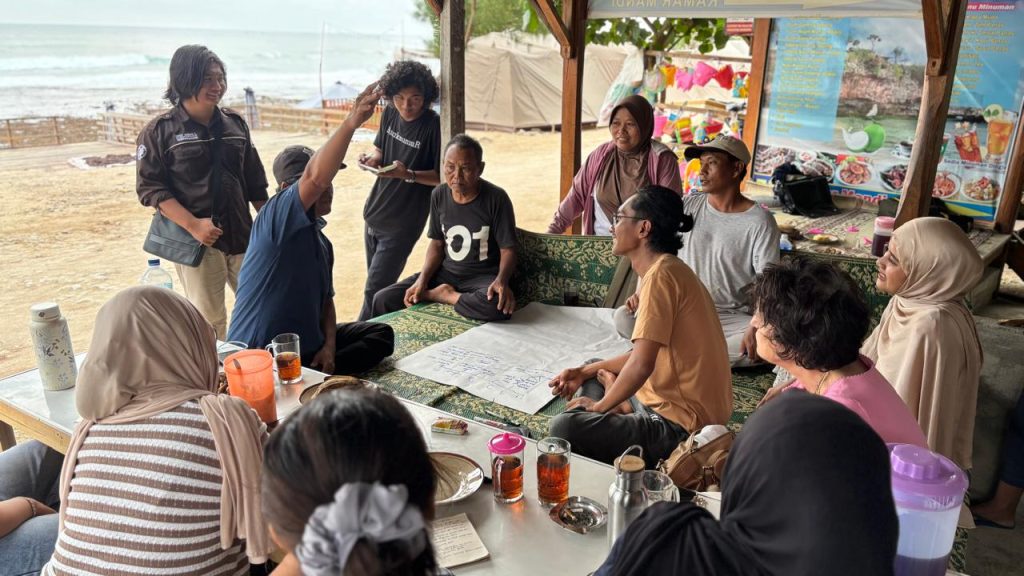
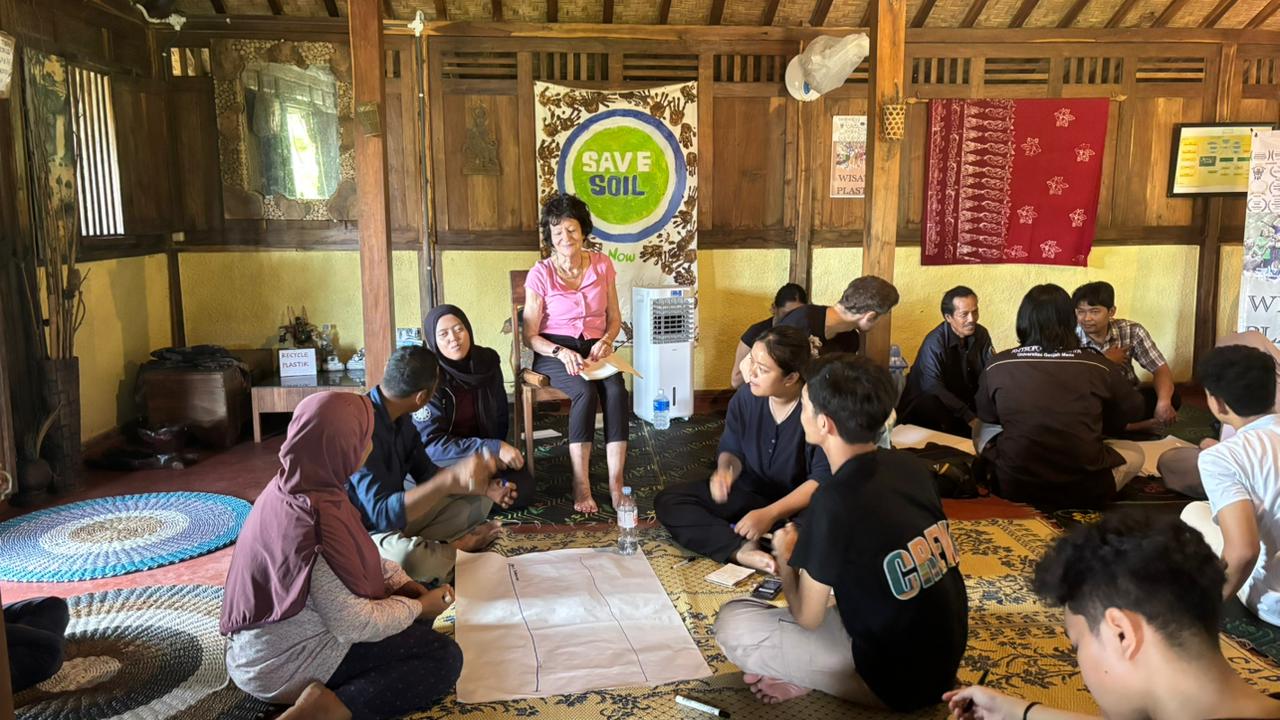
First: the introductory round following an initial recognition of the theory-philosophic academic framework relating the keywords of ‘tourism’ with ‘sustainability’, students’ presentations of selected articles, among others, on ‘Class dynamics of agrarian changes in rural Java’ (Habibi, 2024) or Tourism Development (Isnandar et al., 2025), and secondly, a practical training in the PRA-Methodology and PRA-Philosophy (Chambers, 1994). Second: The phase of ‘participatory data assessment and data evaluation’, located in the village of Watu Kodok/Kelor Kidul/Kelor Lor in the province of Gunungkidul, a union of hamlets that has turned into a beach resort. Community development in Indonesia nowadays calls for a radical change, albeit different from that generated by agricultural modernization – in the form of livelihood diversification, increased association, and community participation in a territory nowadays characterized by globalized terms. The descriptive-analytical perspective focuses on approaches to the point of transformation and leaves open ground for understanding change as a result of inadvertent or deliberate processes. Participatory Rural Appraisal (PRA), a methodology that moves the student-researchers beyond passive observation and requires them to work as active researchers alongside the community. By engaging directly with farmers, local entrepreneurs, and community leaders, the class bridged the gap between academic theory and the practical challenges of community-based tourism (CBT). The philosophy of the ‘Participatory Methodology’ claims participants in the field to be the ‘actors’ and define and reflect on their own concerns – livelihood concerns in various shapes – reflect on themselves and tell ‘their own story’, as of now in times of societal changes and needs in the broader context. The class highlight was to discover and reflect on the processes and outcomes of today’s societal change in the field of ‘tourism’.
Watu Kodok and its neighbouring hamlets, summarized successively under ‘Watu Kodok’, the named place of the class field research, are widely recognized for their white sands and limestone cliffs, yet beneath its popular image as a holiday destination, a complex social landscape is revealed and awaits discovery. The class’s fieldwork was designed to analyse how ‘sustainability’, reflecting the above-mentioned differentiation in perspectives, was interpreted and practiced by residents living within the Watu Kodok environment.
This targeted differentiation in perspectives of ‘sustainability’ relating to tourism was realized by a selective concentration on four target groups: a) the actors following their inherited occupation, like farmers and owners of smaller businesses; b) actors in the field of cultural traditions like gamelan players and batik artists; c) actors in explicitly tourism-oriented engagements like homestay entrepreneurs, actors in the field of waste management; d) actors in the explicit tourism field like the manager of the Jiwa Laut Eco Resort, Bu Ira and her employees, actors in the business of tent rentals and ‘glamping’, and ‘Mas Heri’, the initiator and actor in ‘Fun Games’ for tourists on a beach site.
The research was conducted in three strategic stages, beginning on April 2nd with a focus on social mapping and the historical context. The day began with first PRA-discourses with elderly residents and local actors to discuss their expectations, hopes, and the pressures exerted by external factors such as government policies and investors. In the afternoon, students engaged with farmers to address basic agricultural needs, including fertilizer and seeds accessibility, while analysing how tourism encroaches on their livelihoods, for example, in terms of waste loads and the shade cast by new villa buildings disturbing the growth of crops. After participatorily investigating the tourism related perceptions and concerns of farmers, the students met ‘Warung’ owners and discussed their tourists related business concerns and hopes for the future. This was followed by a Transect drive to build up an initial visual understanding of the locality’s physical and social evolution with the students. The day concluded with a Gamelan performance, which served as a case study for students to explore how local culture strategically maintains its vitality and relevance in the face of modern development.
On April 8th, the second day of fieldwork, the focus shifted towards local enterprises and ecology, as students met with Batik artists, homestay owners, and waste management groups. These sessions were designed to evaluate the recognition of traditional arts by tourists, assess market opportunities and business justice, and determine how visitors are integrated into ‘trash concerns’ and the preservation of the ecological landscape. The day ended with a ‘Fun Games’ session, providing a platform to discuss future expectations for local enterprises. The final phase on April 20th was dedicated to ‘transparency’ realized by a Research Feedback, where students presented their findings to the community for recognition, correction and comment. This “two-way learning” process ensured the research to truly reflect the residents’ reality.
The students, the ‘partners in research’, expressed their appreciation of this activity and found that the field experience challenged their academic preconceptions. Siraj noted that the fieldwork revealed tourism issues to be far more “complex and crazy” than textbooks suggest, while Hizkia valued the opportunity to immerse himself in field insights while reflecting on theory. Rifqy felt the hands-on PRA work provided a clear vision of how sustainable tourism should function, and Fina observed that the intensive experience “somehow connects each one of us.” For others like Tiara and Biel, the course was described as one of the most eye-opening and meaningful decisions of their academic journey.
Turning back to the initially highlighted interpolation between the perspectives of ‘sustainability’ and ‘tourism’, the data of the students in this first training in participatory assessment highlight some outcomes, which were discussed in depth in the final feedback round together with the research participants. With reference to the initially stated indicators defining ‘Sustainability’ relating to tourism development, namely ‘Ecological Integrity’, ‘Economic Viability’, and ‘Social Justice’, the representatives of the named target groups of the research highlighted developments like a) the impact of tourism in terms of environmentally threatening amounts of waste; b) tourism-driven displacements of residents and some tree cutting in beach regions; furthermore they missed the engagement of local communities as true and equally weighted human partners, and c) conservation costs in the course of expanding tourism impacts are solely burdened on the local community, the negligence of the ’the polluter pays’ principle. From the perspective of the SDGs, the study addressed SDG 8 (Decent Work and Economic Growth) by analysing how the Community-Based Tourism approach protects small business owners and warung entrepreneurs from being overtaken by large external investors. Activities on the ground reflect SDG 11 (Sustainable Cities and Communities) by emphasizing the protection of local cultural heritage, such as Gamelan and Batik, as a foundation for community identity. Furthermore, the focus on ‘trash concerns’ and measures on the preservation of the Karst landscape reflects SDG 12 (Responsible Consumption and Production). Finally, the collaboration between international academia, UGM students, and local actors such as the Jiwa Laut team demonstrates a practical application of SDG 17 (Partnerships for the Goals). Ultimately, the fieldwork at Watu Kodok demonstrated that for tourism to be truly sustainable, it must be built upon the voices, needs, and lived experiences of the people on the ground. After all, the community is facing an irreversible drive towards ‘transformation’, which necessitates further investigation and research initiatives that could only be touched upon, but not covered, by the prime training in academic theory and methodology orientation of the UGM class. Last but not least, the discussion with the participants of Watu Kodok indicate that tourism, in its entirety, entails a ‘transformation’ of livelihoods and related values and interpretations. Life will never be as it was before, and the community is and will be in a process of re-definition.
References:
Brundtland, G.H. (1987) Report of the World Commission on Environment and Development: Our Common Future. UN General Assembly Document A/42/427
Chambers, R. (1994). Participatory rural appraisal (PRA): Challenges, potentials and paradigm. World Development, 22(10), 1437–1454. https://doi.org/10.1016/0305-750x(94)90030-2
Isnandar et al. (2025): Sustainable Tourism Development Based on Local Wisdom in Sutojayan Village, Malang Regency: A Participatory Approach in Masterplan Planning.
Muchtar Habibi (2024): Masters of the countryside and their enemies: Class dynamics of agrarian changes in rural Java.